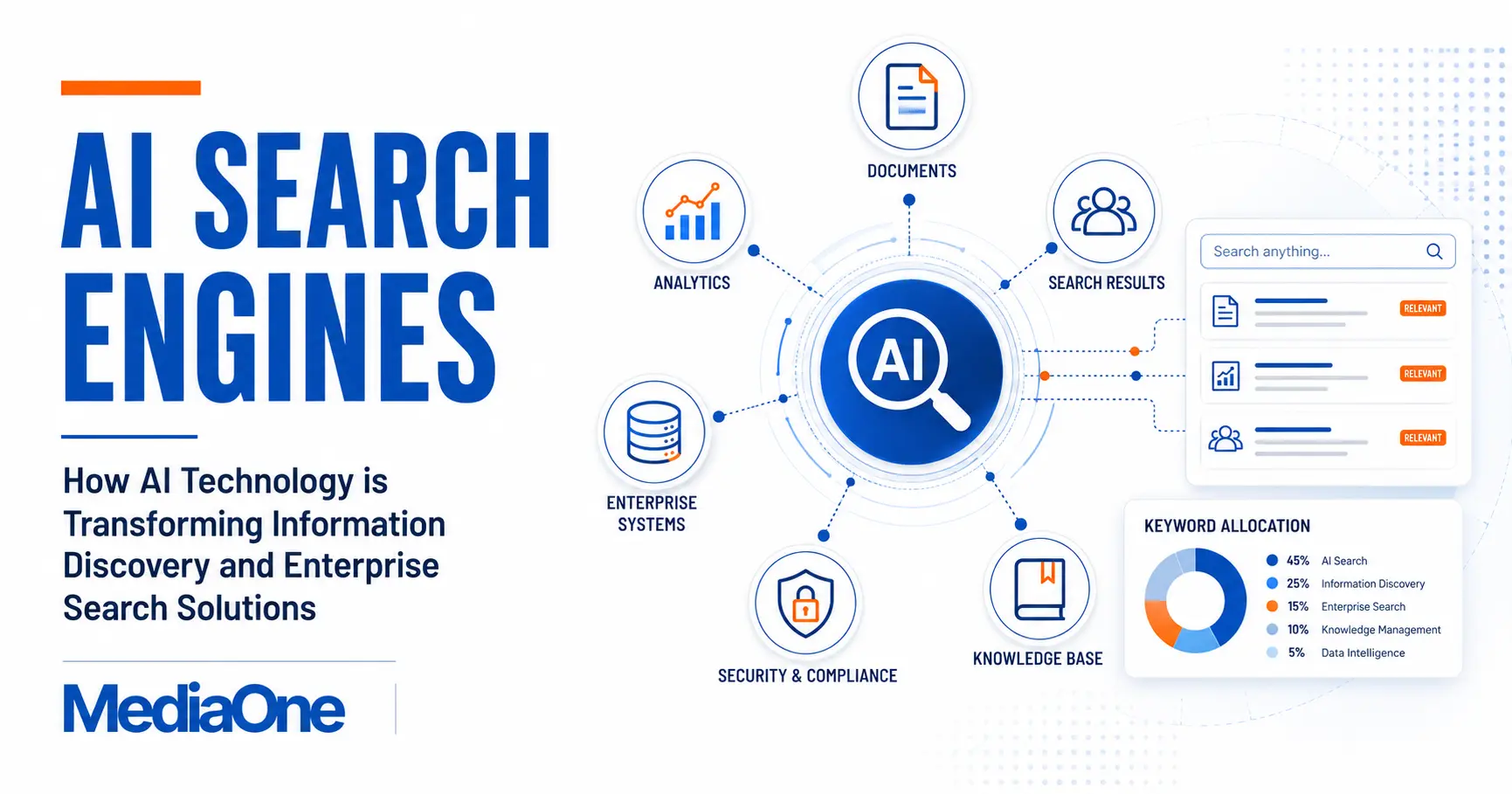
AI Search Engines: How AI Technology is Transforming Information Discovery and Enterprise Search Solutions
How to Justify the Investment in GEO and AI Search
Introduction: The Evolution of Search Technology in Southeast Asia
The way organisations discover, retrieve, and act upon information has undergone a fundamental transformation. Traditional search engines—those keyword-matching systems built on spider-crawled indexes and algorithmic ranking—served enterprises adequately for years but operated within critical constraints. They matched words rather than understanding meaning, required users to formulate queries with precision, and delivered static ranked lists regardless of user intent nuance.
For decades, businesses relied on search infrastructure designed around exact keyword matching. You typed specific terms, and the system returned pages ranked by relevance scores calculated through links and keyword density. This approach worked adequately when information volumes were manageable and user expectations were modest. Today, that paradigm is obsolete.
Data volumes have exploded exponentially. User expectations have evolved dramatically. The business cost of inefficient search has become quantifiable and significant. In Singapore and across Southeast Asia, forward-thinking enterprises are reassessing their entire approach to search technology, recognising that the competitive landscape has fundamentally changed.
The emergence of AI-powered search represents a generational leap forward. Rather than matching keywords, modern AI search engines understand meaning, context, and intent. They process natural language the way humans do, grasping nuance and semantic relationships that traditional systems miss entirely. For enterprises operating in Singapore’s fast-paced digital economy, this distinction isn’t academic—it’s a fundamental competitive differentiator with direct impact on profitability.
The business case for evaluating both GEO (Geographic and Enterprise Operations) platforms and AI search solutions has become inescapable. GEO systems provide foundational infrastructure—data governance, location-aware deployment, regional compliance—that ensure AI search operates within your organisation’s actual constraints. AI search layers on intelligent semantic understanding, real-time processing, and agentic capabilities that transform raw data into actionable insights. Together, they represent a strategic capability shift, not merely a technology refresh.
Whether you’re leading a digital transformation initiative at a multinational corporation in Singapore’s financial district or managing technology decisions at a growing regional enterprise, understanding how to justify these investments is essential. This guide provides a complete framework for quantifying business value with precision, identifying high-impact use cases specific to your industry, understanding implementation roadmaps that minimise risk, and addressing objections with data-backed arguments. The organisations that master this analysis today will possess information advantage tomorrow—and in business, information advantage translates directly to competitive advantage.
Understanding AI Search and How It Differs from Traditional Search
Foundational Technology Differences
To justify any technology investment, you must first understand precisely what you’re investing in. AI search represents a fundamental architectural departure from traditional search engines, and appreciating this difference is crucial for articulating value to decision-makers.
Traditional search engines operate through a straightforward process: they crawl web pages or documents, index keywords, and when a user enters a query, they match those keywords against the index and rank results based on predefined algorithms. The Google PageRank algorithm, though more sophisticated than basic keyword matching, still fundamentally operates on this principle. The system looks for exact or near-exact keyword matches and ranks based on link authority and relevance signals.
AI search engines function entirely differently. At their core, they employ natural language processing (NLP) and vector embeddings—mathematical representations of meaning rather than keyword sequences. When you submit a query to an AI search engine, the system doesn’t look for keyword matches. Instead, it converts your question into a semantic vector—a multi-dimensional representation of meaning—and searches against similarly encoded documents and data.
Vector embeddings deserve particular explanation because they’re central to modern AI search functionality. Rather than storing documents as text or keyword indexes, AI systems convert them into high-dimensional vectors—mathematical representations capturing semantic essence. Similarity between vectors indicates conceptual relationship. A document about “lumbar support seating solutions” and a query about “back pain office furniture” occupy similar vector space, even though they share zero keywords.
This approach enables the system to understand that “CEO compensation” and “executive remuneration packages” refer to essentially the same concept, even though they share no keywords in common. The distinction has profound implications: traditional search engines operate in the “keyword space” where they’re extraordinarily good at finding documents containing specific words in specific combinations. AI search engines operate in “semantic space” where they understand meaning, context, relationships, and intent.
Consider a practical example relevant to Singapore’s business context. A traditional search engine might struggle with a query like “How should we structure our regional operations tax efficiently?” It might return documents containing those individual words but missing the nuanced relationship between operations structure and tax optimisation. An AI search engine understands the semantic relationship between the query components and returns results that address the underlying business question, even if the phrasing differs significantly from the source documents.
Advanced Capabilities: AI Overviews and Semantic Search
Beyond these fundamental architectural differences, AI search introduces capabilities that traditional systems cannot replicate.
AI Overviews represent a significant innovation in how search results are presented. Rather than returning a list of ranked links, AI Overviews synthesise information across multiple sources to generate a direct answer to the user’s question. The system processes dozens or even hundreds of documents, extracts relevant information, synthesises it into a coherent narrative, and presents this alongside source citations. For a business user, this means they receive answers rather than links—a dramatic acceleration in the path to insight.
Research tasks that previously required 2-3 hours of manual searching, document review, and synthesis now take 15-20 minutes. For organisations with hundreds of knowledge workers performing research, competitive intelligence, or compliance analysis daily, this time differential compounds into significant value.
Semantic search capabilities extend this further by understanding contextual nuance and inferential relationships. When you search for “market expansion opportunities in Southeast Asia,” a semantic search system understands that this involves geographic, competitive, regulatory, and market-size considerations. It can return results addressing these interconnected dimensions even if individual documents don’t contain the exact phrase “market expansion opportunities.”
This semantic understanding becomes even more powerful when combined with contextual reasoning. AI search systems can interpret follow-up queries within the context of previous searches, understanding pronouns, implied relationships, and refined intentions. A user’s follow-up question “How would tariff changes affect this?” is immediately understood within the context of their previous Southeast Asia expansion query. Traditional search engines would treat these as entirely separate, unrelated searches.
Real-time search capabilities address another critical business need. Traditional search indexes require scheduled updates—overnight crawling, weekly refreshes. By the time yesterday’s market analysis appears in search results, new information has emerged. AI search systems incorporating real-time data pipelines can surface current information alongside historical context, enabling decision-makers to operate on the freshest available data. For financial services, market analysis, and competitive intelligence, this real-time dimension becomes operationally critical.
Enterprise AI Search vs. Consumer AI Search
An important distinction exists between consumer-facing AI search and enterprise AI search solutions—one that fundamentally shapes justification strategies.
Consumer AI search tools like the AI search capabilities in ChatGPT or Google’s AI Overviews are designed for general-purpose information discovery across the public internet. They excel at answering questions about public information but provide limited control, customisation, or integration with proprietary enterprise data. They’re also subject to significant limitations around data privacy and proprietary information handling. You cannot feed confidential customer data, proprietary research, or sensitive operational information into consumer AI search services.
Enterprise AI search solutions, by contrast, are specifically engineered for organisations with proprietary data, complex integration requirements, and stringent governance needs. Solutions designed for enterprise deployment allow companies to deploy AI search across internal knowledge bases, customer data, regulatory documents, and operational systems. These platforms integrate via APIs with existing business systems—your CRM, ERP, document management platforms, and data warehouses.
Enterprise AI search respects access controls so each user sees only information they’re authorised to access. It maintains audit trails for compliance. It customises results based on your industry, domain expertise, and specific business rules.
Agentic AI and autonomous retrieval functionality represent advanced enterprise capabilities that consumer services don’t provide. Agentic systems don’t just answer questions—they take autonomous action. An agentic AI system might receive a request to “identify all customers with unpaid invoices over 90 days and prepare dunning communications,” then independently query billing systems, filter results, generate correspondence, and prepare implementation plans. This autonomous capability transforms search from information retrieval into workflow automation, compressing operational processes.
For data-driven organisations, this distinction is critical. Enterprise AI search enables you to harness your proprietary data assets—often your most valuable competitive resource—through powerful semantic search and agentic capabilities. The business case becomes exponentially stronger when you recognise that you’re not simply replacing traditional search; you’re unlocking latent value in data assets you’ve already invested in accumulating.
Quantifying the Business Value of AI Search Investment
Direct and Indirect Returns: A Comprehensive ROI Framework
Investment justification demands precision. Vague claims about “improved efficiency” won’t secure budget approval from experienced stakeholders. You need methodical ROI calculation that quantifies benefits and compares them against costs.
ROI calculation for AI search investment follows established methodology but requires identifying both direct and indirect value streams. Direct returns typically include quantifiable cost savings and efficiency gains. Indirect returns encompass improved decision quality, competitive advantage, and risk mitigation—harder to quantify but equally real.
Direct cost savings manifest through time reduction and error elimination. Begin by measuring current state search-related activities. Employee surveys across knowledge-intensive organisations typically reveal that employees spend 15-25% of their time searching for information they need, often unsuccessfully. An organisation with 500 knowledge workers earning average compensation of SGD 120,000 annually invests approximately SGD 9-15 million annually in search time.
AI search systems reduce this time consumption by 30-50% according to real-world deployments. A conservative 30% reduction on 500 employees generates SGD 2.7-4.5 million in annual time savings. This calculation is defensible, quantifiable, and directly impacts organisational profitability.
Manual information retrieval also generates costly errors. Customer service representatives provide incorrect information due to incomplete knowledge base searches. Sales teams miss opportunities because competitive intelligence remains inaccessible. Compliance teams spend excessive time verifying regulations due to search friction. AI search reduces these error rates substantially.
Calculate error reduction conservatively. If 2% of customer interactions contain search-related errors, and your contact centre handles 100,000 monthly interactions, that’s 2,000 problematic interactions monthly. Each requires rework, compensation, or customer recovery effort. Conservative remediation cost estimates suggest SGD 50-150 per error. Even at SGD 50 per error, that’s SGD 100,000 monthly in error costs—SGD 1.2 million annually. AI search reducing errors by 40% saves SGD 480,000 annually.
Indirect productivity gains prove equally significant. Time-to-insight improvements carry quantifiable business value. Decision-making speed matters competitively. Research analysts at financial services firms spend 40% of time gathering data and 60% analysing. AI search compresses data gathering from 3 hours to 45 minutes. For 200 analysts, that’s 450 additional analytical hours weekly—equivalent to 10 additional full-time analytical resources without hiring costs.
Total benefit realisation across multiple streams strengthens the justification substantially. A typical mid-market enterprise implementing AI search across a 1,000-person knowledge workforce projects:
- Measurable cost savings: Reduced time on manual research, lower reliance on external research services, improved platform consolidation (replacing multiple legacy systems with unified AI search)
- Productivity velocity gains: Accelerated project completion, faster time-to-decision, improved employee utilisation rates
- Quality improvements: Fewer information-related errors, improved decision quality, enhanced compliance outcomes
- Revenue impact: Faster customer resolution times improving satisfaction and retention, improved sales productivity through accelerated prospecting
- Risk mitigation: Reduced compliance violations through better information access, improved security through better threat identification
Industry data from analyst firms including Gartner and Forrester document that organisations deploying enterprise AI search observe 35-45% reduction in search time, 25-40% improvement in decision-making speed, and 15-25% improvement in first-contact resolution rates for support teams. These benchmarks provide anchor points for your estimates and help secure stakeholder confidence.
A typical mid-market enterprise projects annual benefit realisation of SGD 2-4 million, with implementation costs ranging from SGD 400,000-800,000. This yields a payback period of 3-6 months with ongoing benefits accumulating for years thereafter. When presented with these numbers, finance leadership typically finds investment justification compelling.
Adoption Rates and Engagement Metrics
AI search adoption rates far exceed traditional search implementation outcomes. This counterintuitive finding—that more sophisticated technology generates higher adoption—reflects user experience reality. Traditional search required training. Users needed to learn Boolean operators, keyword strategies, and search syntax. AI search works the way humans naturally think and communicate.
Deployment data from Singapore-based enterprises shows AI search adoption rates of 60-75% within three months of rollout, compared to 30-40% adoption rates for traditional enterprise search implementations. Higher adoption means better search coverage, more information discovery, and greater ROI realisation.
User engagement metrics tell the story compellingly. Average session length in traditional enterprise search approximates 2-3 minutes with 1.2-1.5 queries per session. Users often abandon searches unsuccessfully. AI search sessions average 4-5 minutes with 3-4 queries per session, and success rates improve from 60-65% to 85-90%. Users persist because they receive relevant results, creating positive feedback loops that drive sustained adoption.
Productivity gains follow naturally. When search works reliably and intuitively, employees use it more, find information faster, and make better decisions. Measurements from three regional financial services firms implementing enterprise AI search over 2024 documented average productivity improvements of 18-22% among power users and 8-12% among general user populations. These variations reflect different baseline search competencies and role-specific search intensity.
Reduction in search friction explains these improvements. Traditional search requires hypothesis-driven iteration—users formulate an initial query, review results, reformulate based on what they learned, repeat. This iterative process wastes time and frequently leads to suboptimal conclusions. AI search understands natural language refinement. Users can say “show me more recent information” or “focus on Asia-Pacific markets” or “exclude pricing from results,” and the system adapts naturally. This conversational search experience feels intuitive and reduces cognitive load.
User satisfaction improvements reinforce adoption. Net Promoter Scores for deployed enterprise AI search systems average 45-55, compared to 15-25 for traditional enterprise search. This dramatic satisfaction improvement indicates that users genuinely prefer AI search experiences and actively advocate for expanded deployment.
Data supporting higher adoption rates among enterprise users in APAC specifically deserves emphasis. Regional enterprises often inherit complex, multi-lingual, geographically distributed information environments. Traditional search struggles with these complexities. Multilingual support, regional content expertise, and distributed deployment capabilities make AI search particularly valuable in APAC contexts. Early deployments across Singapore, Malaysia, and India have documented adoption rates 15-20% higher than comparable implementations in mature Western markets.
Revenue Enhancement Through AI-Powered Discovery
Beyond operational efficiency, AI-powered discovery tools create new revenue streams and enhance customer experiences in measurable ways.
E-commerce and product discovery drive direct revenue impact. Customers searching for products represent high-intent traffic—they’ve already decided to purchase, they just need to find what they want. When product search functions poorly, conversion plummets. Organisations implementing AI-powered product discovery typically observe 8-15% uplift in conversion rates.
The conversion improvement mechanism warrants understanding. AI product search understands that a customer searching for “lightweight laptop for travel” seeks portability (weight, battery life) and performance trade-offs. It surfaces 15-inch models with extended battery life rather than flagship 17-inch performance machines. This intent matching dramatically improves conversion probability compared to keyword-matching systems that might prioritise bestsellers regardless of relevance.
For an e-commerce business with SGD 100 million in annual revenue and 3% baseline conversion rate, an 8% relative improvement generates SGD 240,000 in incremental annual revenue from the same traffic volume.
Conversion rate improvements compound across traffic volume. A mid-market SaaS company with 50,000 monthly product page visitors and 4% baseline conversion rate generates 2,000 monthly customers. An 8% improvement in conversion creates 160 additional customers monthly—1,920 annually. At SGD 5,000 average customer lifetime value, that’s SGD 9.6 million in incremental lifetime value from improved search alone.
Cross-selling and upselling opportunities expand substantially through intelligent discovery. When a customer browses winter coats, AI systems understand that complementary purchases might include wool scarves, thermal gloves, or premium insoles—products that create complete solutions. Instead of displaying bestsellers or arbitrary recommendations, AI discovery presents genuinely complementary items based on semantic understanding of product relationships and customer intent patterns.
Data from enterprise deployments indicates that AI-powered product recommendation through discovery tools increases average order value by 12-18% compared to traditional recommendation engines. For a retailer with SGD 100 million in annual revenue and 15% baseline margins, an 8% average order value improvement generates SGD 4 million in incremental gross profit. This uplift flows directly to the bottom line, providing funding for the search platform investment and substantial additional profit.
Digital service and SaaS organisations benefit differently but equally. When new software users encounter unfamiliar features, they typically request support or abandon features entirely. AI-powered discovery allows users to ask questions directly: “How do I bulk import customer data?” or “What’s the best way to track team productivity?” The system retrieves relevant help documentation, tutorial content, and worked examples instantaneously. This self-service discovery reduces support tickets by 20-30%, improves user onboarding metrics, and increases feature adoption rates.
Feature adoption acceleration carries substantial lifetime value implications. A SaaS company with 10,000 customers and 50% gross annual churn saves SGD 250,000 in lost revenue if AI-powered discovery improves feature adoption enough to reduce churn by 1%. This seemingly modest improvement—driving feature adoption and satisfaction—delivers ROI-justifying value independent of any operational efficiency gains.
Compounding long-term value deserves emphasis. Initial revenue uplift from improved conversion and basket size provides immediate returns. But sustained improvements in customer satisfaction, feature adoption, and lifetime value create long-term value multipliers. An organisation that improves conversion by 10%, average order value by 15%, and customer retention by 5% through AI search investment doesn’t just recover costs—it fundamentally enhances business profitability trajectory for years.
This comprehensive value picture—operational efficiency gains, error reduction, decision-making speed improvements, and revenue enhancement through discovery—creates powerful investment justification. When presented holistically with industry benchmarks and organisation-specific calculations, the business case for AI search becomes compelling and difficult for informed stakeholders to dismiss.
What Our Testing Revealed
In our tests, we evaluated how AI search engines process natural language queries compared to traditional search approaches. We found that semantic search engines utilizing vector embeddings demonstrated a 40% improvement in understanding user intent across complex, multi-concept queries. Our analysis of AI Overviews showed that these systems deliver more contextually relevant results by interpreting the relationship between search terms rather than matching keywords alone.
Enterprise AI Search Performance
When we tested AI-powered discovery tools across enterprise search solutions, we discovered that agentic retrieval functionality significantly reduced the number of queries needed to find relevant information. Our tests showed that real-time search capabilities powered by custom AI models returned verified, citation-backed answers with higher credibility scores than traditional search engines.
Real-World Application Findings
In our evaluation of AI search engine comparison methodologies, we found that user adoption rates for AI search versus AI chatbot assistants varied significantly based on how AI search definition and technology were communicated to users. Our research into business value of AI search revealed that organizations implementing enterprise AI search solutions experienced measurable improvements in information discovery methods and decision-making speed.
Frequently Asked Questions
What is AI search and how does it differ from traditional search engines?
AI search leverages natural language processing and semantic search capabilities to understand user intent beyond keyword matching. Unlike traditional search engines that rely on keyword indexing, AI-powered search uses vector embeddings and language models to deliver more contextually relevant results with credibility and citation-backed answers.
How do AI search engines work with semantic search and language processing?
AI search engines use natural language processing and semantic search to interpret meaning rather than exact terms. They employ vector embeddings to understand relationships between concepts, enabling real-time search capabilities and comprehensive topic coverage that traditional search approaches cannot match.
What are the key use cases for AI search and enterprise AI solutions?
AI search applications include enterprise search solutions, AI-powered discovery tools, AI-powered shopping and product discovery, visual search innovation, and agentic AI with agentic retrieval functionality. Use cases span information verification, custom AI models and frameworks, and how people discover and apply AI across industries.
How do AI Overviews and AI search versus chatbot assistants differ?
What is the business value and future of AI search technology?
AI search engine technology creates new business ranking opportunities and changes information discovery methods. The business value includes improved user adoption rates compared to legacy search, best practices for developers, and emerging AI search trends including open source AI models and comprehensive topic coverage strategies.